Doenet Workshop 2026 Show and Tell
Doenet Workshop 2026 Show and Tell
- You can find the full list of Show and Tell presentations on the Doenet Community page.
Fences are a trick. Fences don’t keep people out, they trick people into keeping themselves out.
— Joey Comeau, Author
Provided here is a summary of the resources I shared during the final day’s “Show and Tell”.
accessible-math Resources Github Repo
I quickly shared a few tools content authors could use for creating more accessible math documents:
- LaTeX templates for TeXLive 2025+ and LuaLaTeX for creating PDF/UA Compliant documents.
- A collection of accessible fonts for math, text, and code environments.
- A collection of colorblind-friendly palettes and a python script for generating palettes with color-vision deficiency simulations of them.
All of these are part of my broader repository where I am regularly updating materials for creating accessible math documents
Github Jekyll Website
With the help of Dr. Steven Clontz during the “Introduction to Github” section, I was able to setup this Jekyll Github site. It’s a work in progress as I continue to update/construct the functioning stylesheet and backend integration to better maintain this site over time. Keep checking back to see continuing progress! I was able to setup this blog in a few hours using these tools. I’ll continue working on it throughout the summer.
Demonstration of Doenet’s Spreadsheet Component
After working with Dr. Stephen Frezza on a semantic version of his 8-digit Base 16 Longhand Addition Doenet activity, I remembered how I got all my Cryptography activities working 5 years ago teaching Math5248 at the University of Minnesota. As the component never came up during the workshop, I used the Show and Tell as an opportunity to share one of my old activities on generalizing shift to affine ciphers as a means of demonstrating the functionality of this component.
<spreadsheet name="example">
  <row>
    <cell>Hello</cell>
    <cell>World</cell>
  </row>
  <row>
    <cell>=a1</cell>
    <cell>=a2</cell>
  </row>
  <row>
    <cell>=a1&" "&a2</cell> <!-- concatenate to "Hello World" -->
  </row>
</spreadsheet>
This would have made Dr. Frezza’s component much easier to code, but it was an interesting challenge to do it using only native Doenet components. I’m sure one of us will rewrite the activity using this in the future, but I’m glad we got it working regardless.
“Fill in the Blank” scaffolded proof.
I showed an example of my (in progress) pedagogical UI for my lecture notes going forward with a Doenet Activity integrated to construct the proof of the integration by parts formula in Calculus II. You can view the updated version based on feedback from the workshop.
Demonstration of Writing Answer Validations
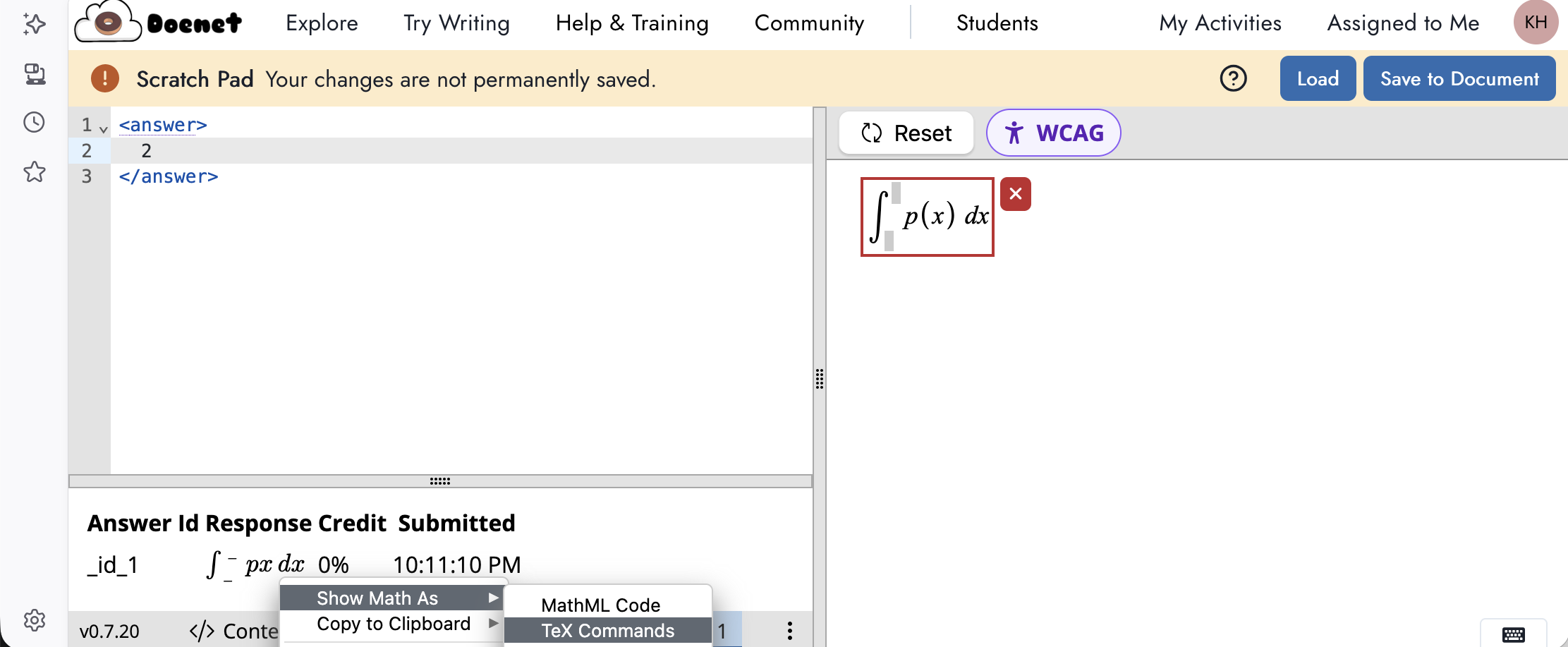
I showed how the built-in tools in the Doenet editor’s “Submitted Responses” box could be used to create more advanced answer validation and student feedback like the one demonstrated in the prior example. Right-clicking on the MathJax gives you the ability to see exactly what the parsed entry looks like so it can be used in answer validation. See the image below for an example.
Other Important Details
This workshop used an AIM-style approach for fluidly generating working sessions.
Working Sessions I participated in
- Tuesday (both sessions): Getting started with GitHub Collaboration
- We were able to all colloborate on a project, learning from both the owner and contributor views of forking, changing, and submitting a pull request on a project. This was a great, hands-on session for everyone who participated!
- Wednesday Morning: Doenet Software Development
- Wednesday Afternoon: Accessibility Strategies for Authors
- I’ll try and post a follow-up on this. We discussed several challenging situations and came up with general strategies for addressing them in creating accessible course materials with dynamic, interactive elements.
- Thursday Morning: Value Proposition of Doenet within the Greater Ecosystem
- This small session with Dr. Steven Clontz and Dr. Lilly Webster discussed and inventoried many of the current tools available for anyone interested in tools for developing, designing, or using accessible course material in the Open Source ecosystem. We separated them into certain processing layers, and I hope to write a follow-up post on the tools organized in a few different ways in the future.
- Thursday Afternoon: Misc. Coworking Group
Other Important Ideas/Collaborations
- I had several great conversations with Dr. Christina Safranski about teaching Calculus. Dr. Safranski is one of the contributing authors for the OER Calculus Textbook Active Calculus, which uses Doenet for their “preview” activities and are slowly increasing the incorporation with exercises.
- I spent several hours working with Oscar Levin, Ph.D. discussing the design of PreTeXt, and possible synergies in the work on my own pedagogical UI with both PreTeXt and DoenetML.
- Professor Anurag Katyal showed of several interesting Algebraic Geometry activities developed in Doenet. We plan to collaborate on turning several of them into outreach activities appropriate for Math Circles or other community games in the near future, and I hope to develop a future MathPath session around them.
Thanks to the
- The Doenet crew for organizing a great workshop,
- the NSF for providing travel funding,
- and all the great participants this week.
It was great meeting many new colleagues and catching up with old friends this week. Thanks for the numerous interesting problems, intriguing ideas, and camaraderie you all brought to the workshop. I look forward to many future collaborations!