(MATH122 - Calculus II) Course Notes
Author: Kris Hollingsworth, PhD (Dr. ℋ)

Class 10: (7.1) Area Between Curves

Today’s Plan
  • Learn another application of definite integration.
  • Learn a new way to think about integration
Today’s Assignments
Warm-up Activity
Exercise: Back to Riemann Sums
  1. Draw a Riemann sumRiemann sumA Riemann sum is a method for approximating the total area underneath a curve on a graph, otherwise known as an integral. It works by dividing the area into shapes (usually rectangles) and summing their areas. This is often written as S=i=1nf(xi)ΔxS=\sum_{i=1}^n f(x_i)\Delta x where xix_i is a point in the ii-th subinterval, f(xi)f(x_i) is the height of the rectangle, and Δx=ban\Delta x=\frac{b-a}{n} is the width. that approximates the area of interest (blue but not green).
  2. Analyze the formula to find the area of a representative slice.
  3. Use the definition of a definite integral to find the same formula for this area we did in the warm-up.
Visual Aid
Example 1

Find the area enclosed by the curves f(x):y=(x1)2,g(x):y=(x1)2+4(x1)f(x): y=(x-1)^2,\qquad g(x): y=-(x-1)^2+4(x-1)

Steps
  1. Find the bounds of integration.
  2. Determine which curve is on top.
  3. Write down the correct integral.
  4. Evaluate the integral.
Solution

Step 1: Find the bounds of integration.

Carefully graph each curve or solve (x1)2=(x1)2+4(x1). (x-1)^2=-(x-1)^2+4(x-1). Yields x=1x=1 or x=3x=3.

Step 2: Determine which curve is on top.

Use graphical reasoning about the curves (they are parabolas, after all.) Alternative check at x=2x=2. f(2)=1andg(2)=5,f(2)=1 \qquad \text{and} \qquad g(2)=5, so gg is on top.

Step 3: Write down the correct integral. 13[g(x)f(x)]dx=13[4(x1)2(x1)2]dx.\int_1^3 [g(x)-f(x)]\;dx = \int_1^3 [4(x-1)-2(x-1)^2]\;dx.

Step 4: Evaluate the Integral. 13[4(x1)2(x1)2]dx=83.\int_1^3 [4(x-1)-2(x-1)^2]\;dx = \frac{8}{3}\;. (You should show all your work in the computation, either expanding the quadratic or performing a uu-substitution.)

Alternative solution.

Notice that setting u=x1u=x-1 at the very beginning simplifies the work significantly, rather than waiting to substitute until the integral step. Choosing to simplify early like this reflects a deeper understanding of how the expressions are related, rather than just following a sequence of steps.

This kind of insight doesn’t usually happen right away—it’s built gradually through sustained effort and reflection. As you work more problems, you’ll begin to recognize patterns: which substitutions simplify things and when to try them. Developing that intuition is a long-term goal, and every problem you wrestle with and work through intentionally helps move you in that direction.

Example 2

Setup a math expression that represents the area of the region bounded by the curves
y=x1,y2=2x+6.y=x-1,\qquad y^2=2x+6.

Warning

Before you open any of the boxes below, try to solve the problem on your own first. If you get stuck, use the hint to guide your thinking. Only open the visual aid if you still need support after that. The goal here is to build your own reasoning and problem-solving skills, and that means spending time working through uncertainty and making your own connections. Resist the urge to reveal everything too quickly—give your brain a real chance to grapple with the ideas first.

Steps
  1. This time, I would highly recommend plotting both curves.
    • The first curve is a standard linear function, so it should be immediate.
    • With a small bit of work, the second curve can be done nearly as quickly as y2=2x+6=2(x+3).y^2=2x+6 = 2(x+3). This immediately tells us that the plot is a parabola with vertex at (3,0)(-3,0) opening in the positive xx direction. It’s also compressed by a factor of two from left to right. This immediately provides all the information necessary to sufficiently graph the curve.
  2. Identify the points of intersection and which curve is on top either algebraically or graphically. If working graphically, be certain to verify your work algebraically. Pictures can lie!
  3. Try to setup the appropriate integral, but do so by carefully analyzing the picture you have drawn. You can check your initial work using the visual aid.
Visual Aid

Prompt

What do you notice that is different about this picture from any of our prior examples of Riemann sums?

Example 3

For Example 3, we’ll repeat Example 2, but we’ll look for a way to simplify the calculation from two integrals to one. I’d recommend looking at your sketch (or the picture above) to think through how we might accomplish this.

You can also look at the visual aid for the problem below and see if you can predict what will change and try and setup an appropriate integral in the answer validator to see if you’ve got it figured out!

Visual Aid
Completed on Board

We will work through the solution as a class, with the instructor leading and students contributing key steps, ideas, and justifications throughout.

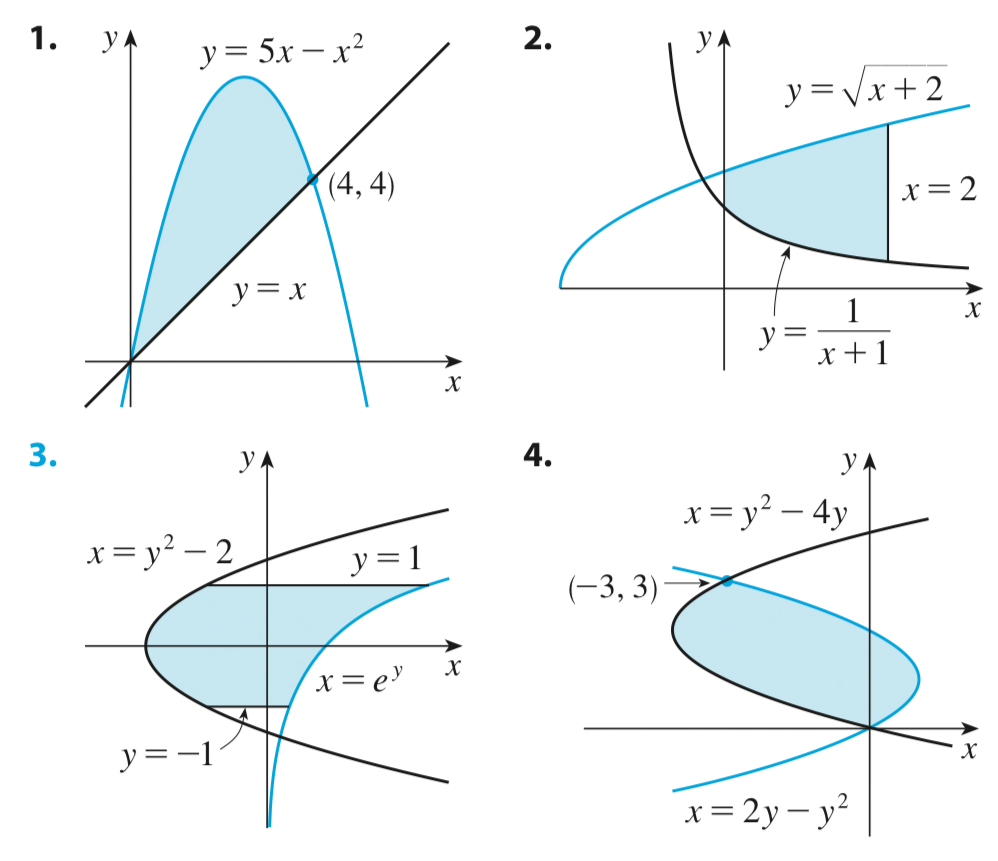
Exercise

Determine the minimal number of integrals required for integration with respect to each variable.

Four images of regions bounded by curves with multiple intersections.
Work in class

Students will begin with individual or collaborative work time, followed by a guided solution on the board developed through student input. Be prepared to explain your reasoning and contribute to each step of the process.

Example 4 (Time Permitting)

Find the area between the curves y=sin(x)y=\sin(x) and y=cos(x)y=\cos(x) on the interval [0,π2]\left[0,\frac{\pi}{2}\right].

Visual Aid
Steps
  1. Find the point of intersection.
  2. Setup the integral(s).
  3. Calculate the Final Answer.
Solution

You should obtain 0π/4[cosxsinx]dx+π/4π/2[sinxcosx]dx.\int_0^{\pi/4}[\cos x - \sin x]\;dx + \int_{\pi/4}^{\pi/2}[\sin x - \cos x]\;dx. The calculation is left as a practice exercise, although you may check your work here.